
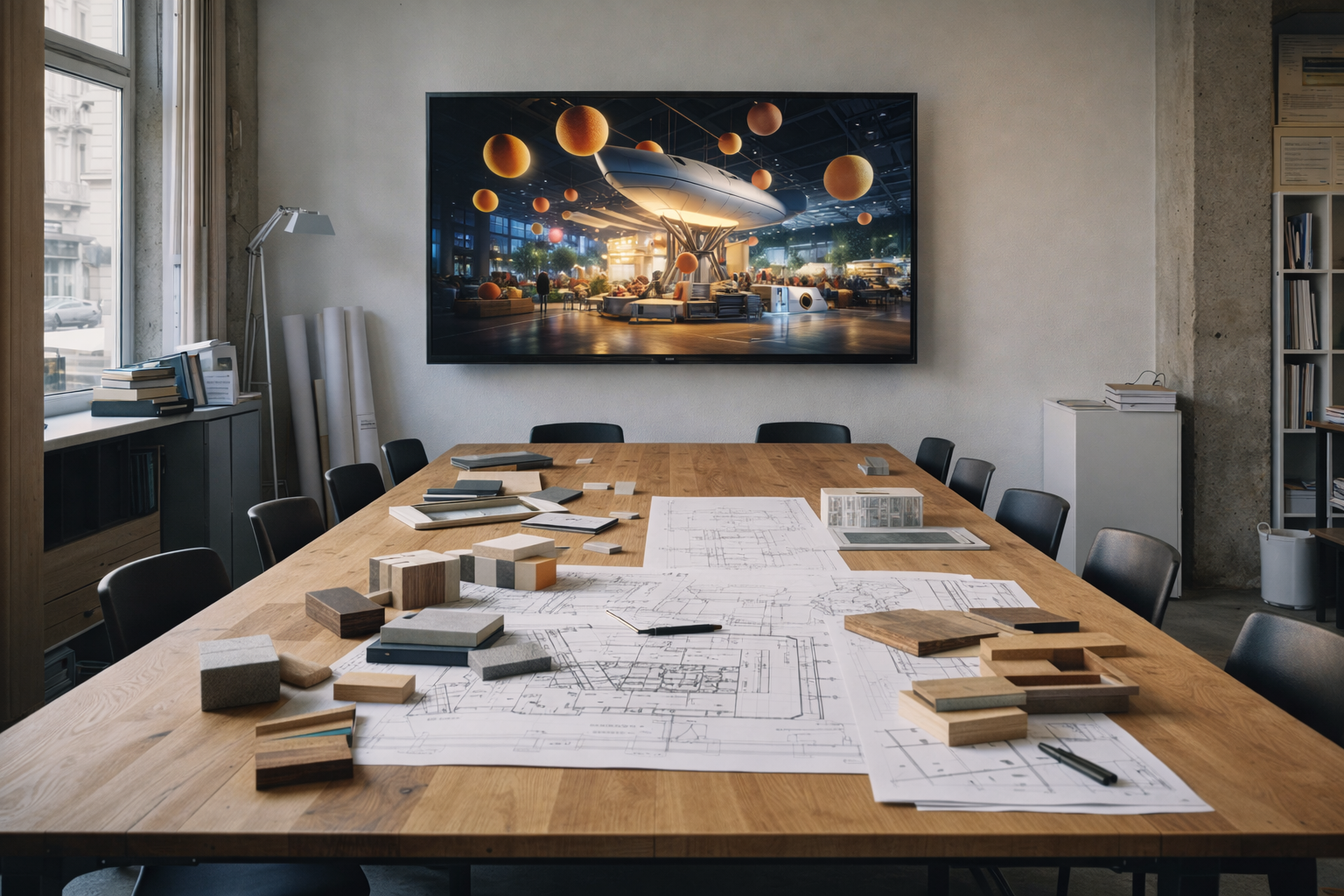
The early phase of brand experience projects has changed fundamentally. What once began with sketches, references and alignment meetings now often starts with fully realised visuals generated in minutes. A festival lounge with sparks suspended mid-air. A pop-up structure featuring oversized floating fruit. A futuristic mobile bar that looks production-ready before a single technical drawing exists.
For clients and agencies alike, this shift matters. AI speeds up early thinking and turns abstract ideas into visible form. Even without a design background, decision-makers can express preferences more clearly. Alignment happens faster because everyone is reacting to the same image.
But a convincing image is not the same as a concept that can be built.
AI generates visual plausibility, not structural feasibility. It does not calculate structural stability, assess material compatibility or account for transport, installation time, labour effort and real market pricing. It produces a compelling image, not a validated solution. This is where friction begins.
The Advantage: Visual Clarity at Speed
Early visualisation has clear advantages. AI helps give shape to creative ideas before time and budget are heavily invested. Marketing teams can share concrete options instead of abstract descriptions. Conversations become more focused, and direction becomes clearer.
For many clients, this feels liberating. Decisions are made with greater confidence when there is something tangible to evaluate. In this sense, AI strengthens early dialogue and sharpens feedback.
The Disconnect: When Image Meets Implementation
The challenge begins when AI-generated images are treated as realistic options. An AI render can make a structure appear lightweight and effortless. In reality, achieving that look may require costly materials, complex engineering or difficult transport solutions.
The image suggests simplicity. Production reveals complexity.
The result is a growing gap between what is imagined and what can actually be delivered within real-world constraints.
The Hidden Shift in the Offer Phase
As a consequence, agencies that both design and produce, as well as production partners, increasingly perform substantial technical translation before they can even submit an offer. The image has to be interpreted. Materials need to be defined. Structural systems must be clarified. Logistics and installation sequences have to be planned. Only then can reliable pricing begin.
This work is necessary, but it often goes unnoticed. Technical checks and validation shift into the offer phase without being formally recognised or compensated. At the same time, the polished render has already set expectations. When adjustments are required, they can feel like compromises rather than improvements. Budget discussions then become reactive instead of strategic.
The Budget Gap
AI-generated images often look high-end by default. They are trained on visually striking reference material, where dramatic lighting, premium finishes and ambitious scale are common. As a result, the output tends to feel polished and impressive, regardless of the actual budget behind the project.
When cost implications are not addressed early, alignment happens too late. Expectations are shaped by the visual, and feasibility has to follow afterwards. The more a project is defined by aesthetics before cost and construction are considered, the greater the risk of misalignment.
Integrating Reality Earlier
None of this means AI should be avoided. It can improve clarity, speed and engagement in the conceptual phase. The question is not whether to use AI, but how.
When AI visuals are used as starting points and technical expertise is involved early, ambition and feasibility remain aligned. When a visual direction is fixed before it has been tested against reality, tension is almost inevitable.
Brand experience operates at the intersection of storytelling and construction. Creative ambition and operational logic do not compete; they depend on each other.
Looking Forward
The discussion should not revolve around whether AI image generation is useful. It clearly is. AI visuals can serve as inspiration, reference and mood direction. But they are a starting point, not a solution.
For agencies that design and produce what they create, feasibility is part of the concept from the beginning. Their strength lies in developing ideas that already consider structure, materials and cost while preserving the original intent. That expertise should be trusted.
When the render meets reality, the strongest projects are those where vision and buildability are developed together from the start.
Written by Aisha N. van der Staal and Gregor Wepper